
By: Amy Catron
- Kennesaw’s display of Confederate history
- The fight of many residents to keep monuments standing
- Why this history is controversial
KENNESAW, Ga.—When researching about Kennesaw State University in the Atlanta suburb of Kennesaw, Georgia, 24-year-old Devyn Wilkins was drawn to the growing population and the advertised diversity of the area. After moving to KSU into his dorm, he was warned by his roommate about the downtown Kennesaw area—that he should keep his distance from Wildman’s Civil War Surplus store that is across from a park that flies the Confederate battle flag.
When deciding to attend KSU, Wilkins saw that the school’s campus and website was plastered with photos of diverse groups of students hanging out on the campus green, diverse students working in corporate jobs around Atlanta, and read about the many multi-cultural groups and clubs at the school.
“I had heard that Kennesaw was a really diverse area and was progressive,” Wilkins said. “I think a lot of people do, because it’s so close to Atlanta. I didn’t realize until I moved here how much the city glorifies their part in the Civil War.”
The city of Kennesaw has recently been the site of many protests in the midst of the Black Lives Matter movement after the death of George Floyd in the hands of the police. People have gathered downtown because of Kennesaw’s proud displays of Confederate monuments, history, and memorabilia. There has been a divide in the beliefs of the residents of Kennesaw over whether this history should be celebrated, or whether it is offensive and should be placed in a museum with proper context.
Downtown Kennesaw’s History
The city of Kennesaw’s logo sports the General locomotive, which was the train that Union soldiers stole and attempted to take up north during the Civil War in 1862, according to The Southern Museum of Civil War and Locomotive History’s website. Confederate Conductor William Fuller chased the raid, and eventually captured and hanged Union Sgt. John Scott who was awarded the Medal of Honor.
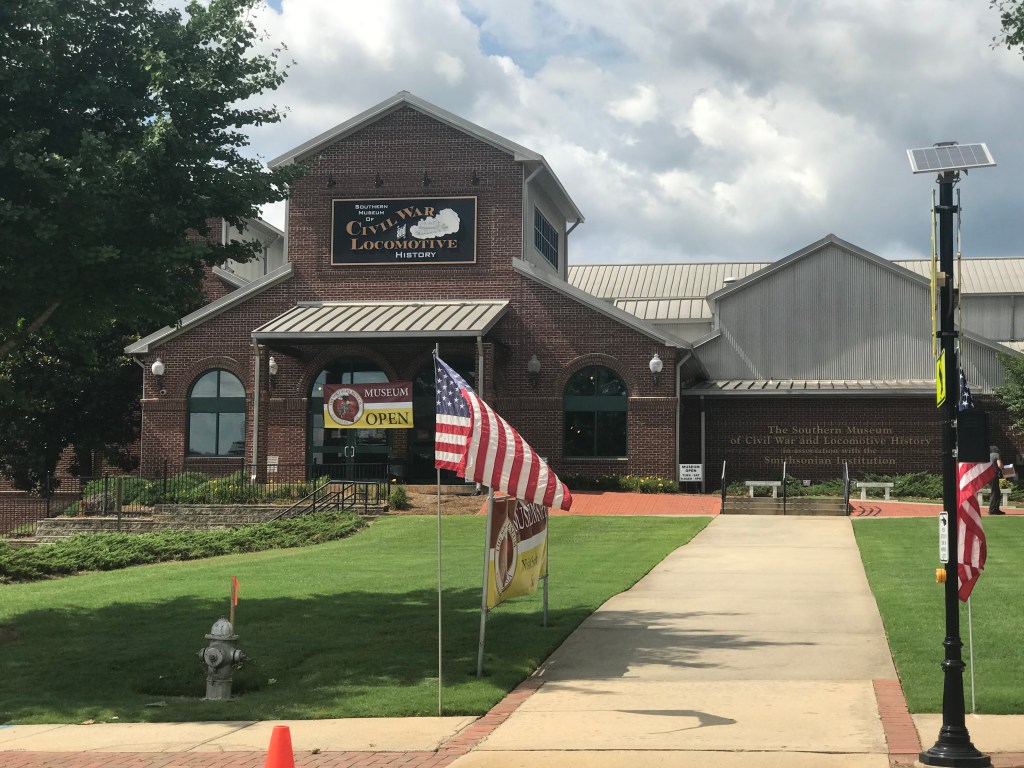
The General locomotive is now displayed inside of The Southern Museum of Civil War and Locomotive History, along with an exhibit called “Post-Civil War Perspectives,” which dives into the country’s views of the Civil War, including the “Lost Cause” narrative.
The Library of Virginia’s website says that the “Lost Cause is an interpretation of the American Civil War that seeks to present the war, from the perspective of Confederates, in the best possible terms.”
One of the most well-known locations in Kennesaw is Wildman’s Civil War Surplus store, which sells Confederate and Nazi memorabilia, and displays Ku Klux Klan robes in the windows. Up until last month, the Confederate Battle flag was flown downtown in Memorial Park next to Georgia’s state flag and the American flag by the city government of Kennesaw.
Controversial History
In June, Kennesaw’s City Council heard arguments from residents about whether to take down the Confederate battle flag that flew in downtown’s Memorial Park, just across the railroad tracks from The Southern Museum. The city council voted to take down the Confederate flag after passionate pleas for the symbol to be taken down were heard.
Most Kennesaw residents at the meeting asked the council to take down the flag, saying it was a racist symbol that represents hate and oppression, and conflicts with the values Kennesaw stands for today. There were a handful of residents at the council meeting who voiced their opinions that the flag should stay flown due to its historical and cultural significance.
The city of Kennesaw’s vision statement is: “To cultivate a progressive, vibrant community fostering an environment of opportunity, inclusion, and security, we strive to be a city inspired by innovation, guided by ethics, and enhanced by diversity,” according to the city of Kennesaw’s website.
This was brought up in the meeting by a Kennesaw resident who said that the outdated laws in the city and memorials to the Confederacy contradict this vision statement.
Similair to the city of Kennesaw’s statement, KSU’s statement boasts of diversity: “Kennesaw State will exemplify the power and promise of a student-centered, research-driven university. Authentically diverse, uniquely attainable and endlessly impactful, we will unleash the potential in every student we serve,” according to KSU’s website.
What Stands Today
The city of Kennesaw’s youth baseball team for the 10-year-old age group is called the “Kennesaw Generals,” and is often referred to as “The Little Generals.” The team’s logo features a train with a star emblazoned on the front.

Kennesaw resident John Thomas said that he believes that monuments and reminders of the south’s role in the Civil War is hurtful to those in the Black community.
“As a black man in America I see symbols of hate everywhere,” Thomas said. “Yes, the Civil War is a part of our history, but it’s a part of history that reminds me of how I would have been treated when those things were happening.”
Thomas said that when he sees symbols such as the Confederate flag, or that baseball teams and city of Kennesaw signs have the General on them, it tells him that is what Kennesaw stands for.
“It’s not about honoring history,” Thomas said. “Kennesaw is a growing and diverse place, but a place that I don’t want to take my kids to because of the symbols that remind us of the hate of the South.”
These monuments that honor Confederate soldiers are legally required to stay, including the carvings of Robert E. Lee and other Confederate leaders on the side of Stone Mountain in Stone Mountain, Georgia. This is because of a 2001 Georgia law that makes it illegal to remove any monument that honors Confederate soldiers.
“It shall be unlawful for any person, firm, corporation, or other entity acting without authority to mutilate, deface, defile, abuse contemptuously, relocate, remove, conceal, or obscure any privately owned monument, plaque, marker, or memorial which is dedicated to, honors, or recounts the military service of any past or present military personnel of this state, the United States of America or the several states thereof, or the Confederate States of America or the several states thereof,” according to § 50-3-1 of Georgia state law.
 The KSU Beat